Tree-planting programs can do more harm than good
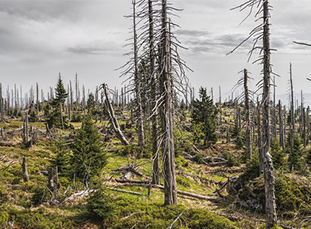
Conventional wisdom holds that all tree planting is good for fighting climate change and supporting wildlife, but research shows some techniques can be a problem.
A USDA forest ecologist in the Sierra Nevada of eastern California, North was at the center of a new experiment in forestry with global implications. In September 2014, the King Fire ripped through 150 square miles (390 square kilometer) of the Eldorado National Forest. North was part of a team of scientists studying new ways to bring the forest back.
That put him at the center of one of the hottest new fields of climate adaptation—and a quiet revolution in his own field. Throughout the 20th Century, the Forest Service grew trees by, well, planting them. “We’d go out to a big fire or clear cut,” North said, of his college summers working as a tree planter, “and every ten to twelve feet we’d plant another pine tree. At the end it would look just like a corn crop.”
They called it “pines in lines,” and over the last century it became industry standard as the Forest Service replanted the native mixed-species forests of Western conifers with trees for commercial harvest.
But that method—relying not only on armies of sowers but also foresters who come back, years later, to “clean up the mess”—has become prohibitively expensive for a Forest Service facing the intersection of a more volatile climate with flat funding.
“Forest Service spending on fire suppression has gone from 15 percent of the budget to 55 percent,” Agriculture Secretary Sonny Perdue said in 2017. “That means we have to keep borrowing from funds that are intended for forest management.”
So the hunt is on for ways that tomorrow’s forests can better care for themselves. In January, North was part of a team of 25 University of California and Forest Service ecologists and siliviculturalists arguing for a new model of forestry that would replace the old straight-line monocultures with new methods emphasizing variety of both spacing and species. Evidence in support of this new model comes not just from California but from China, the Amazon, Europe, and elsewhere. It’s a more natural way of doing forestry, and one that also puts these experts on the front lines of a pivotal struggle to slow climate change.
The Eldorado is one case study in what the World Resources Institute (WRI) calls “degraded lands:” part of an estimated 2 billion hectares—a land area about the size of Australia, as shown on this interactive map—ready for restoration.
Restoration is a term-of-art that, after nearly two centuries of industrial deforestation, often means new forests. Trees are about a quarter carbon, and as they grow (or burn) they bind (or release) about four times their weight in carbon dioxide. For all the hype around carbon-capturing machines, says Mary Booth, an ecologist at the Massachusetts-based Partnership for Policy Integrity, when it comes to drawing down carbon, “forests are the only proven, scalable technology we have.”
Yet at the heart of North and company’s work is a disquieting fact: the wrong reforestation policies can be worse than no reforestation at all.